
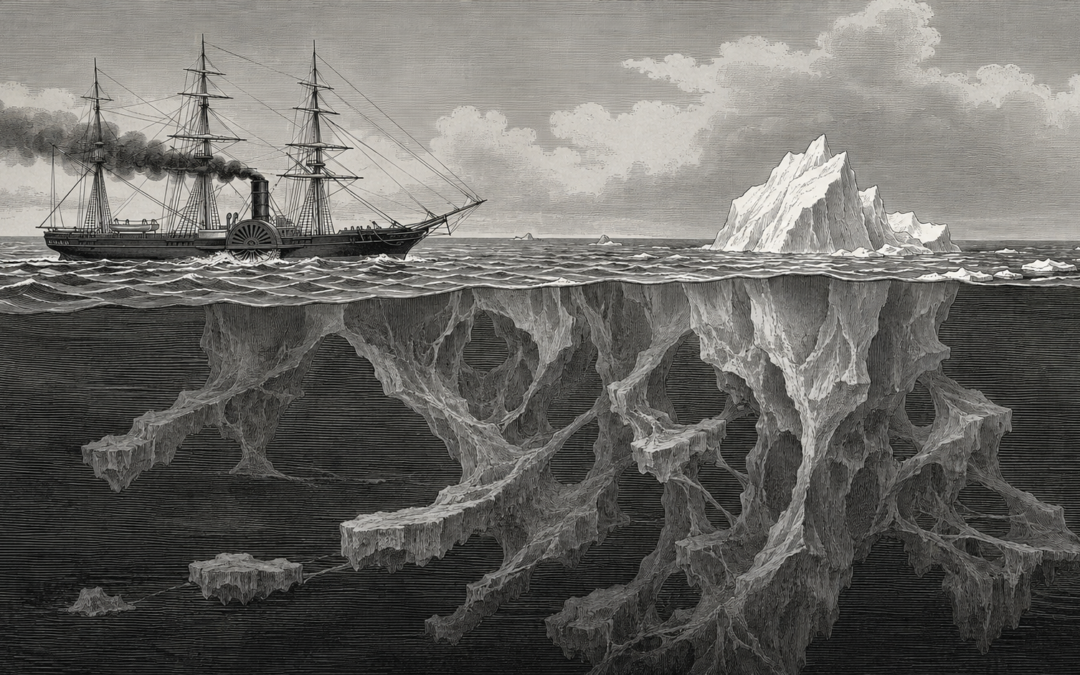
The Economics of AI in Insurance, Part 3
By James W. Moore
Key Takeaways
Better underwriting does not create more risk-bearing capital. Carriers buy reinsurance for reasons that go well beyond confidence in their own risk selection, including capital, liquidity, volatility, concentration, and price.
The last major leap in risk quantification, catastrophe modeling, did not reduce the need for risk transfer. It made risk easier to divide, price, structure, and finance. AI may follow a similar path.
The complication is that better individual decisions do not necessarily create a more diversified market. If carriers increasingly rely on similar models, platforms, data, and decision systems, underwriting can improve at the account level while errors become more correlated across the industry.
Better risk selection is not better diversification.
Part 2 of this series ended with a proposition: AI does not eliminate uncertainty. It changes where uncertainty lives.
If uncertainty moves, capital follows. This article asks what happens when that movement reaches the organizations whose entire business is financing uncertainty.
The intuitive story is simple enough. If AI makes primary carriers better at selecting and pricing risk, they should become more confident in their books. More confidence should mean higher retentions and less reinsurance.
Follow that logic far enough, and AI starts to look like a slow leak in the reinsurance business model.
The problem is that reinsurance has never been driven by underwriting confidence alone.
Better Underwriting Does Not Create More Capital
Underwriting capacity and risk-bearing capacity are not the same thing.
AI may allow a carrier to evaluate more submissions, price difficult accounts more efficiently, identify better risks, and enter markets that were previously too expensive to underwrite. Part 2 explored where that newly abundant underwriting capacity might go.
None of that automatically changes the balance sheet.
A carrier that becomes much better at deciding which risks to write still has the same statutory surplus. Its tolerance for earnings volatility does not suddenly increase. Catastrophe concentration does not disappear. Rating-agency and regulatory capital expectations do not vanish because the underwriting team has better tools.
That matters because reinsurance does two jobs at once.
It manages risk by reducing volatility, concentrations, and the financial impact of large losses. It also manages the balance sheet by preserving liquidity, reducing the amount of capital a carrier needs to commit, and supporting growth that the carrier may not want to finance entirely on its own.
Academic work on reinsurance demand has found both functions repeatedly. Better underwriting can change which risks a carrier wants. It does not automatically change how much loss the carrier can afford, or wants, to keep.
Retention Is Not Confidence
The easy AI argument assumes retention works like a confidence score: the better the underwriting, the more risk the carrier keeps.
The evidence does not support such a simple relationship.
A 2006 study by Cassandra Cole and Kathleen McCullough, using U.S. property-casualty insurer data from 1993 through 2000, found that reinsurance purchasing varied with company size, profitability, adverse loss development, geographic and line-of-business concentration, organizational structure, and price. Higher reinsurance prices reduced demand. Smaller and less profitable insurers generally bought more.
Confidence in risk selection barely appears in that list.
Anne Gron’s study of catastrophe reinsurance makes the point even more clearly. Using program-level data covering roughly 60 percent of the U.S. catastrophe reinsurance market from 1987 through 1993, she found that when catastrophe reinsurance became more expensive, carriers raised retentions, reduced limits, and accepted more coinsurance.
Retention moved with the price of protection.
That matters for the AI question. Retention is not a referendum on how well a carrier understands its book. It is a purchasing decision. The carrier is balancing the cost of protection against capital, volatility, liquidity, and its own appetite for loss.
Gron found something else worth noting. Larger insurers showed greater demand for catastrophe reinsurance, not less, even though their balance sheets should have been better able to absorb a major event.
One reason is straightforward: catastrophe reinsurance delivers cash when the carrier needs it most. After a major event, liquidity can matter almost as much as solvency. Even a large insurer may prefer to have committed protection in place rather than raise capital in the middle of a crisis.
So the useful question is not whether better underwriting makes carriers buy less reinsurance.
It is which parts of the loss distribution become more attractive to retain, and which constraints still make transferring the rest economically rational.
AI may change desired retention long before it changes permissible retention.
The Last Time Risk Became Easier to Model
If we want to know what happens when the industry suddenly gets much better information about risk, we do not have to speculate. It has happened before.
The best historical comparison is catastrophe modeling.
Before modern catastrophe models were widely adopted, insurers leaned heavily on historical losses, rules of thumb, and relatively coarse estimates of where their exposures were concentrated. Hurricane Andrew changed that in 1992.
The NAIC describes Andrew as the event that pushed the industry away from historical averages and toward probabilistic modeling. Karen Clark, who founded the first commercial catastrophe modeling firm, has described how model-based estimates of Andrew’s losses looked implausibly high compared with conventional expectations, until the claims arrived and showed how badly the old methods had underestimated the event.
Several insurers did not survive the lesson.
What happened afterward matters more than the history itself.
Better information did not make risk transfer less important. It made catastrophe risk easier to measure, segment, price, and structure. Reinsurance programs could be built with a much clearer view of where losses might emerge and how different layers of protection should respond.
Better measurement also brought in new capital.
The years after Andrew produced a wave of new catastrophe reinsurers, many built around catastrophe modeling. Later, the same modeling infrastructure helped make insurance-linked securities practical. Investors could participate in catastrophe risk because models gave them a way to estimate losses that historical experience alone could not provide.
Better information did not shrink the market for risk transfer. It expanded the universe of capital willing to hold the risk.
Recent history shows how quickly the structure can still move when the economics change.
The 2023 reinsurance reset was driven by capital pressure, accumulated losses, and pricing, not by better modeling. But it showed how much risk can move between carrier and reinsurer when conditions change. Guy Carpenter has described pressure on catastrophe programs that had often attached around a two-to-three-year return period being pushed toward one-in-ten, potentially leaving an individual carrier with another $50 million to $100 million of retained loss before protection responded.
By 2024, Guy Carpenter reported that the reinsured share of global catastrophe losses had fallen to 14 percent, compared with a pre-2023 average of 20 percent.
The important point is not that better information caused that shift. It did not.
The point is that the market already has the quantitative machinery to move risk between balance sheets when price, capital, or appetite changes.
There is one more lesson from the catastrophe-model era.
Better models did not eliminate model error. Major events kept exposing blind spots, missing loss mechanisms, loss amplification, and underestimated secondary perils. The response was recalibration, not abandonment.
AI is likely to follow the same pattern. Better tools will improve decisions, but they will also reveal new ways the tools can be wrong.
The precedent is useful: the last major improvement in risk quantification did not eliminate risk transfer. It changed how risk was divided, priced, monitored, and financed.
Better Information Does Not Mean Symmetric Information
Reinsurance has always had an information problem.
The cedent knows more about its own underwriting, insureds, claims behavior, and appetite than an outside reinsurer can. The reinsurer has its own models, market knowledge, and experience, but it is still evaluating a portfolio someone else built.
AI does not erase that imbalance. It may sharpen it.
A carrier with strong account-level data may get much better at deciding what to write, what to reject, what to retain, and what to cede. That is good underwriting. It also means the composition of what gets transferred may become more informative.
If the cedent can identify the risks it most wants to keep with greater precision, the reinsurer should care about what remains.
But reinsurers have an advantage of their own.
They see risk across many cedents, geographies, industries, and lines. AI may improve their ability to find patterns across portfolios that no single carrier can see. The carrier may know more about the individual risk. The reinsurer may know more about how similar risks behave across the market.
The market has historically managed part of this information problem through relationships.
Research using two decades of U.S. property-liability data found that longer insurer-reinsurer relationships were associated with greater reinsurance volume, stronger insurer profitability, and better insurer credit quality. The interpretation is straightforward: over time, reinsurers learn their cedents.
They watch underwriting discipline through cycles. They see how claims emerge. They learn how management behaves when conditions change.
Brokers sit in a third position, across submissions, placements, pricing, and capacity from many markets at once. Whether that becomes a durable AI advantage is still an open question.
The broader point is simpler: AI may make the reinsurance market more informed without making information more symmetric.
Everyone’s analysis gets better. Nobody’s view becomes complete.
What Happens When the Book Changes Faster Than the Relationship?
That relationship point raises a practical question.
A reinsurer’s confidence in a long-standing cedent is built over years. It comes from observed underwriting discipline, portfolio behavior, claims development, and management decisions.
What happens when the underwriting system changes faster than that knowledge can accumulate?
An AI model update can change acceptance criteria, pricing thresholds, risk appetite, geographic mix, industry concentration, and limits without changing the company, the management team, or the treaty.
Suppose a reinsurer has supported a carrier for ten years. The carrier deploys a substantially revised underwriting model in March.
How much of the reinsurer’s decade of accumulated knowledge still describes the book it is covering in September?
This is not an argument that reinsurance contracts ignore underwriting change.
Publicly available reinsurance agreements contain provisions requiring notice of, or consent to, material changes in underwriting requirements and practices. The public examples are weighted toward life and annuity business because property-casualty treaty wordings are usually private, but the basic machinery is not new.
The AI question is about speed.
Traditional monitoring was built around the pace of human underwriting change: revised guidelines, new management, a shift in appetite, a new class of business, a change discussed at renewal.
Model-driven portfolio change can happen faster and may be harder to see from outside.
Is a significant model revision a material change in underwriting practice? Should it be disclosed the way a new underwriting manual would be? What does a reinsurer need to see, and how often, to keep its understanding of the book current during the treaty year?
AI may not create a new contractual problem.
It may create a tempo problem inside an old one.
Better Risk Selection Is Not Better Diversification
This is where the reinsurance question gets harder.
AI can help a carrier answer one question very well:
Is this an attractive risk?
The reinsurer has to answer another:
What happens when all of these attractive risks sit in the same portfolio?
Those are not the same problem.
A portfolio can be full of individually good risks and still be dangerous if too many of them respond to the same event, the same economic shock, or the same analytical mistake.
The catastrophe-model market already gives us a warning.
Commercial catastrophe modeling became concentrated among a relatively small number of vendors. Researchers at Oxford modeled what happens when too many insurers rely on too few risk models.
Their simulation produced a straightforward result: as model diversity fell, the market became more fragile. Profitability declined, defaults increased, and reinsurance reduced the damage but did not eliminate it.
The evidence boundary matters.
The concentration is real. The losses are simulated.
We have evidence that the industry relies on a relatively small number of catastrophe models. We do not have a historical loss event proving that model concentration will produce exactly the outcome the simulation predicts.
But the mechanism is relevant to AI.
Carriers are unlikely to build their AI capabilities in isolation. Many will share foundation models, underwriting platforms, data vendors, third-party analytics, cloud infrastructure, training sources, and decision architectures.
That does not mean every carrier will make the same mistake.
It means some mistakes may become less diversifiable.
That is the uncomfortable part. Each carrier’s decisions can improve while the industry’s decision processes become more alike.
A carrier can become more certain about every risk in its portfolio while the industry becomes less diversified in how it reaches those conclusions.
Better risk selection is not better diversification.
That may be the most important reinsurance question AI creates.
What Changes for Reinsurance?
If AI improves underwriting without eliminating capital constraints, liquidity needs, volatility, information asymmetry, or correlation, reinsurance does not disappear.
Its structure may change.
Retention. Carriers may want to keep more of the risks they understand well and can finance comfortably. But retention will still respond to price, capital, volatility, and liquidity. Better underwriting does not force the answer in one direction.
Attachment. AI could support more deliberate choices about where protection begins. Some portfolios may be comfortable moving farther into the tail. Others may still want lower attachment because of growth, capital, or earnings volatility.
Limits and treaty design. Better recognition of concentration and correlation may preserve, or even increase, demand for extreme-loss protection. Better portfolio information may also allow risk to be transferred more precisely rather than through broad cessions.
Pricing and monitoring. Reinsurers may care more about underwriting quality, data quality, model governance, portfolio stability, and transparency around material model changes. Historical portfolio performance becomes less useful when the process generating the portfolio has changed.
Capital. The catastrophe-model experience suggests that better measurement can attract new capital. If AI makes difficult risks easier to quantify, some of the capital willing to support them may come from outside traditional reinsurance.
The strategic shift underneath all of this is straightforward.
Primary carriers may get much better at deciding which risks they want.
Reinsurers may become even more important in deciding how those risks behave together, and where the capital supporting the tail should come from.
A Second Problem, for Another Day
This article has focused on AI as a decision system, changing how insurers understand and select risk.
AI creates a separate reinsurance problem as an insured exposure: silent AI coverage, concentration among foundation-model providers, shared cloud dependencies, and the possibility of correlated technology losses accumulating across portfolios that otherwise look unrelated.
That deserves its own analysis.
For now, the important distinction is simple: AI as a tool insurers use, and AI as a risk insurers cover.
Conclusion: What Reinsurers Are Paid to Understand
AI can reduce some forms of underwriting uncertainty. It can improve selection, pricing, segmentation, and portfolio analysis.
But reinsurance demand never depended primarily on carriers being uncertain about individual risks.
Capital constraints remain. Liquidity needs remain. Tail losses, concentration, correlation, and information asymmetry remain.
The catastrophe-model era showed what the industry does when risk becomes easier to measure. It builds more precise structures, moves risk between balance sheets, and attracts new pools of capital.
AI is unlikely to break that pattern.
What AI adds is a new complication. If many carriers improve underwriting through increasingly similar decision systems, the industry can become more precise at the account level while becoming less diversified in how it reaches its decisions.
The reinsurer sits where those individual decisions become a portfolio.
So the strategic question is not whether better underwriting makes reinsurance unnecessary.
It is which uncertainty the carrier should keep, which uncertainty it should transfer, and what increasingly interconnected uncertainty the reinsurer is being paid to understand.
Recommended Reading
This article is Part 3 of The Economics of AI in Insurance.
- Part 1: Insurance Isn’t Coal: Why Jevons Paradox Doesn’t Quite Fit Insurance
- Part 2: What Happens When Underwriting Gets Cheap?
- Part 3: The Coming AI Questions for Reinsurers
Sources
- Anne Gron, “Insurer Demand for Catastrophe Reinsurance,” in Kenneth A. Froot, ed., The Financing of Catastrophe Risk (University of Chicago Press, 1999): https://www.nber.org/chapters/c7947
- Cassandra R. Cole and Kathleen A. McCullough, “A Reexamination of the Corporate Demand for Reinsurance,” Journal of Risk and Insurance 73, no. 1 (2006): https://doi.org/10.1111/j.1539-6975.2006.00170.x
- James R. Garven and Joan Lamm-Tennant, “The Demand for Reinsurance: Theory and Empirical Tests,” Insurance and Risk Management 71, no. 2 (2003): https://www.revueassurances.ca/wp-content/uploads/2016/03/2003_71_no2_Garven.pdf
- Guillaume Plantin, “Does Reinsurance Need Reinsurers?” Journal of Risk and Insurance 73, no. 1 (2006): https://www.gplantin.net/jori_169.pdf
- David Mayers and Clifford W. Smith Jr., “On the Corporate Demand for Insurance: Evidence from the Reinsurance Market,” The Journal of Business 63, no. 1 (1990): 19–40:
https://doi.org/10.1086/296481 - James R. Garven, James I. Hilliard, and Martin F. Grace, “Adverse Selection in Reinsurance Markets,” The Geneva Risk and Insurance Review 39, no. 2 (2014): 222–253:
https://doi.org/10.1057/grir.2014.13 - Torsten Heinrich, Juan Sabuco, and J. Doyne Farmer, “A Simulation of the Insurance Industry: The Problem of Risk Model Homogeneity,” Journal of Economic Interaction and Coordination 17 (2022): https://doi.org/10.1007/s11403-021-00319-4
- NAIC, “Catastrophe Models (Property)”: https://content.naic.org/insurance-topics/catastrophe-models-(property)
- Karen Clark, “The Evolution of Catastrophe Modeling Since Hurricane Andrew,” Insurance Journal, May 16, 2022: https://www.insurancejournal.com/magazines/mag-features/2022/05/16/667461.htm
- Moody’s (RMS), “30 Years On from Hurricane Andrew”: https://www.moodys.com/web/en/us/insights/insurance/30-years-on-from-hurricane-andrew-managing-a-storm-of-floridas-own-making.html
- Alexander Braun and Carolyn Kousky, “Catastrophe Bonds,” Wharton Risk Management and Decision Processes Center (2021): https://impact.wharton.upenn.edu/wp-content/uploads/2023/08/Cat-Bond-Primer-July-2021.pdf
- American Academy of Actuaries, “Insurance-Linked Securities and Catastrophe Bonds” (2022): https://www.actuary.org/wp-content/uploads/2022/06/ILS_20220614.pdf
- Guy Carpenter, “Strong Reinsurer Appetite Drives Excess Property Catastrophe Capacity at January 1” (December 30, 2024): https://www.guycarp.com/company/news-and-events/news/press-releases/january-1-2025-reinsurance-renewal.html
- Guy Carpenter, “Peter Askew Talks About Retentions at January 1 Renewals” (2023): https://www.guycarp.com/insights/2023/04/guy-carpenter-peter-askew-talks-about-retentions-January-1-renewals.html
AI Disclaimer: This content was created with assistance from artificial intelligence technology. While content is based on factual information from the source material, readers should verify all details directly with the respective sources before making business decisions.
