
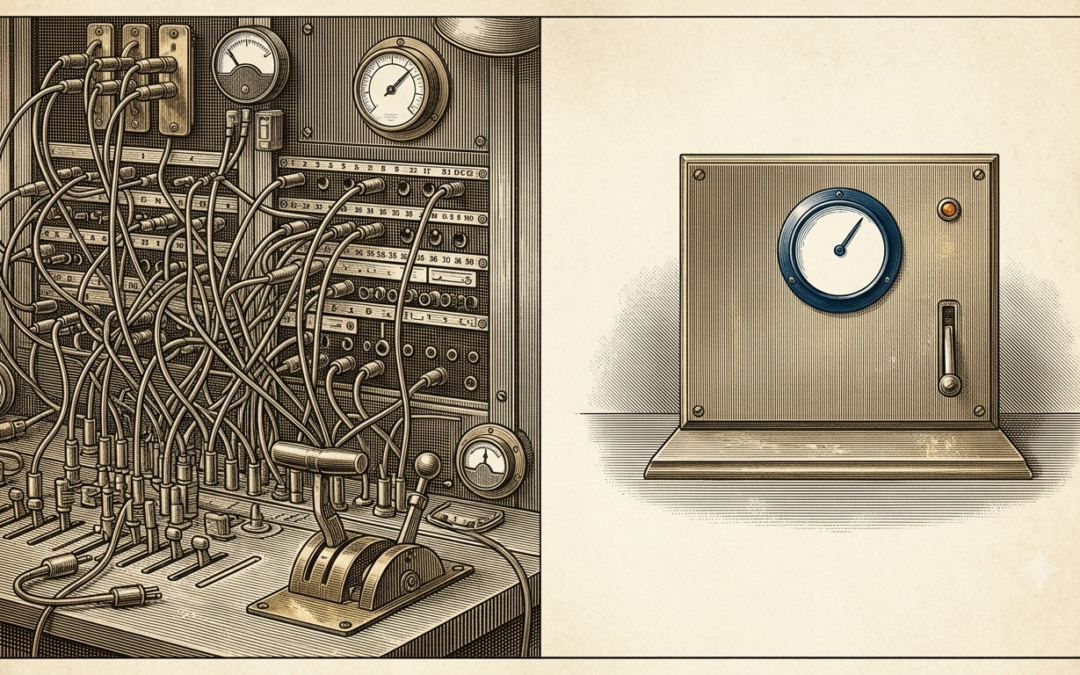
It Will Make the Interface Disappear.
By James W. Moore – Opinion
For the past year, one of the recurring predictions around AI has been that some AI-native startup will eventually replace the traditional agency management system.
The pitch is easy to understand.
The current AMS experience can feel dated. There are too many screens, too many menus, too many clicks to accomplish tasks that should be simple. The promise of a clean AI interface is appealing.
Imagine replacing a complicated dashboard with a conversation:
“Prepare me for tomorrow’s renewal meeting.”
“Find the accounts with missing documentation.”
“Show me every commercial client with a potential coverage gap.”
That future is coming.
The mistake is assuming that the interface is the entire system.
It isn’t.
The AMS is not just the thing employees click on all day. It is the accounting system, the policy record, the compliance trail, the carrier connection point, and the operational history of the agency.
That foundation matters.
AI is going to dramatically change how people interact with agency management systems. It may even make the current interface largely disappear.
But the infrastructure underneath becomes more important, not less.
The Three Layers of an Agency Management System
When people talk about replacing the AMS, they usually focus on one layer: the screen.
That is understandable because the screen is what users experience every day.
The menus.
The tabs.
The forms.
The reports.
The dozens of clicks required to find information that should be easy to access.
Every software company building an AI solution understands this frustration. A simpler interface is a compelling value proposition.
But the screen is only one layer.
The second layer is the foundation.
That includes: policy records, accounting, commissions, carrier downloads, permissions, audit history, compliance records, and integrations
Nobody thinks much about this layer when everything works.
Everyone thinks about it when something breaks.
The third layer is the one nobody puts in a sales presentation.
The glue.
This is where the real-world complexity of running an agency lives.
It includes:
- download exceptions
- document reconciliation
- agency-specific workflows
- custom fields
- unofficial procedures
- the workaround a senior CSR created three years ago that everyone now depends on
This is also where data quality often suffers.
Every agency has some version of institutional knowledge that exists only because someone remembers how things are really done.
AI will dramatically change the first layer.
It will put pressure on the third layer.
And it will make the second layer more valuable.
Why the Incumbents Have an Advantage
An AI tool is only as useful as the information it can access.
A renewal assistant needs renewal history.
A coverage review tool needs policy information.
A workflow assistant needs to understand how the agency actually operates.
That information already exists inside the AMS.
It may not be perfectly organized. It may not be clean. It may include years of accumulated history from real customers, real claims, real renewals, and real business decisions.
That history has value.
The major AMS vendors have something difficult for a startup to recreate: context.
A startup can build a great AI model.
The AMS already has decades of agency knowledge sitting underneath it.
That changes the equation.
The platform does not need to become smarter than everyone else overnight. It needs to make the intelligence it already has easier to access.
The Hidden Opportunity: Fixing the Training Problem
One of the biggest overlooked impacts of AI in agency management may have nothing to do with automation.
It may be training.
A surprising amount of new employee training is not about insurance.
It is about software.
New employees learn:
- where information lives
- which screens matter
- which fields need to be completed
- which reports are actually used
- which shortcuts everyone follows
- which procedures exist because “that’s just how we do it”
Every agency has these.
They are part of the operating culture.
The problem is that much of this knowledge lives with experienced employees instead of inside the system.
AI creates the possibility of changing that.
Instead of teaching someone dozens of navigation steps, an agency may eventually teach employees how to ask better questions.
Instead of:
“Go to this screen, select this option, filter this field, export this report, then attach it here.”
The interaction becomes:
“Show me the accounts renewing next month that have incomplete documentation.”
The system understands the workflow.
The employee understands the outcome.
That is a significant change.
AI Could Improve Data Quality
There is another interesting possibility.
Everyone talks about how AI needs clean data.
That is true.
But AI may also become one of the best tools for improving data quality.
Today, many data rules exist in people’s heads.
Tomorrow, those rules can become part of the workflow.
That is a meaningful shift. Data governance stops being something people are told to do and becomes something the workflow enforces.
Today that instruction sounds like: “Please remember to complete the activity log.”
Soon it may sound like: “I can’t complete this workflow until the required documentation is present.”
AI could identify:
- missing documentation
- incomplete renewal information
- inconsistent classifications
- missing activity records
- workflow steps that were skipped
The system can help enforce the standards that agencies already know matter.
The goal is not simply better AI.
The goal is a better operating system for the agency.
We’ve Seen This Pattern Before
This same pattern has appeared across other industries.
Microsoft did not lose productivity software because AI arrived. Instead, AI became part of the productivity tools people were already using.
Adobe did not disappear because generative AI arrived. AI became another capability inside the creative workflow, and the comparison is closer to this argument than it first appears. Photoshop did not go away. What changed is how much of it a person needs to understand to get something done. A skilled user is still valuable, but a casual user can now accomplish things that once required real expertise. The product stayed. The visible complexity did not.
Healthcare provides an especially interesting comparison. Electronic health records became deeply embedded infrastructure because they hold the operational and compliance history of the organization. AI companies have built valuable tools around those systems, but the underlying record remains essential.
Insurance has many of the same characteristics.
It is regulated.
It is documentation-heavy.
It depends on history.
Switching costs are high.
The system of record matters.
Where This Argument Does Not Apply
There will be exceptions.
A brand-new agency with no history to migrate has different needs.
An MGA with a focused workflow may have an opportunity to build something AI-native.
A simple personal lines operation may not need the same level of infrastructure.
A ground-up AI agency management system is possible.
But it is important to understand what that actually means.
It means building accounting.
It means building carrier connectivity.
It means building compliance workflows.
It means building trust with agencies that are responsible for protecting customer records.
At that point, the challenge is much bigger than building a better AI interface.
What Happens to the AI Startups?
Most successful AI companies in insurance will likely fall into one of several categories.
Some will become features.
They will build something valuable, prove the market, and eventually be acquired by or integrated into larger platforms.
That is not a failure. In enterprise software, it is often the natural path.
Others will become permanent complements.
Companies like DocuSign and Zoom became valuable because they solved important problems without trying to replace every system around them.
A different group deserves careful attention. These are companies that enter the market as integrations but gradually attempt to become the place where agency work begins and ends. That strategy is understandable. Owning the workflow is valuable. But it puts them in direct competition with the systems they originally depended on. The challenge for these companies is not intent, it is structural. Carrier reconciliation, trust accounting, and compliance audits are not optional, and a company built around owning the workflow eventually has to solve for them too.
A smaller number will try to become the new system of record openly, upfront about what they are attempting.
That is the hardest path.
The technology is only part of the challenge. The company must convince agencies to move the operational foundation of their business.
That is a much higher bar.
The Architecture Is Changing
Earlier this year, I wrote that AI did not just change the tools. It changed the architecture.
The same idea applies here.
In the architecture piece, I argued that AI lowers the cost of coordination between people. The same principle applies inside software. For decades, users have spent enormous amounts of time translating business intent into software instructions. They learned the language of the system. AI reverses that relationship. The system begins learning the language of the business.
That is the shift running underneath everything in this piece. It is changing where work happens, how people interact with systems, and how knowledge moves through an organization. But the foundation still matters, and in many cases AI increases its value, because it finally gives people a good way to use it.
A Quieter Kind of System
The agency management system of the future may look very different.
It may have fewer visible screens.
Fewer menus.
Fewer reasons for employees to memorize where everything lives.
It may feel smaller while actually doing much more.
The best AI implementation may be the one that removes friction so effectively that users stop thinking about the software at all.
The future of the AMS probably is not about making users interact with another layer of technology.
It is about removing the technology barrier between people and the work they need to accomplish.
The AI tools that win in insurance will not necessarily be the ones that replace the management system.
They will be the ones that make you forget you are using one.
Related Reading
This piece builds directly on three earlier IIAI articles:
AI Disclaimer: This content was created with assistance from artificial intelligence technology. While content is based on factual information from the source material, readers should verify all details directly with the respective sources before making business decisions.
